Overview
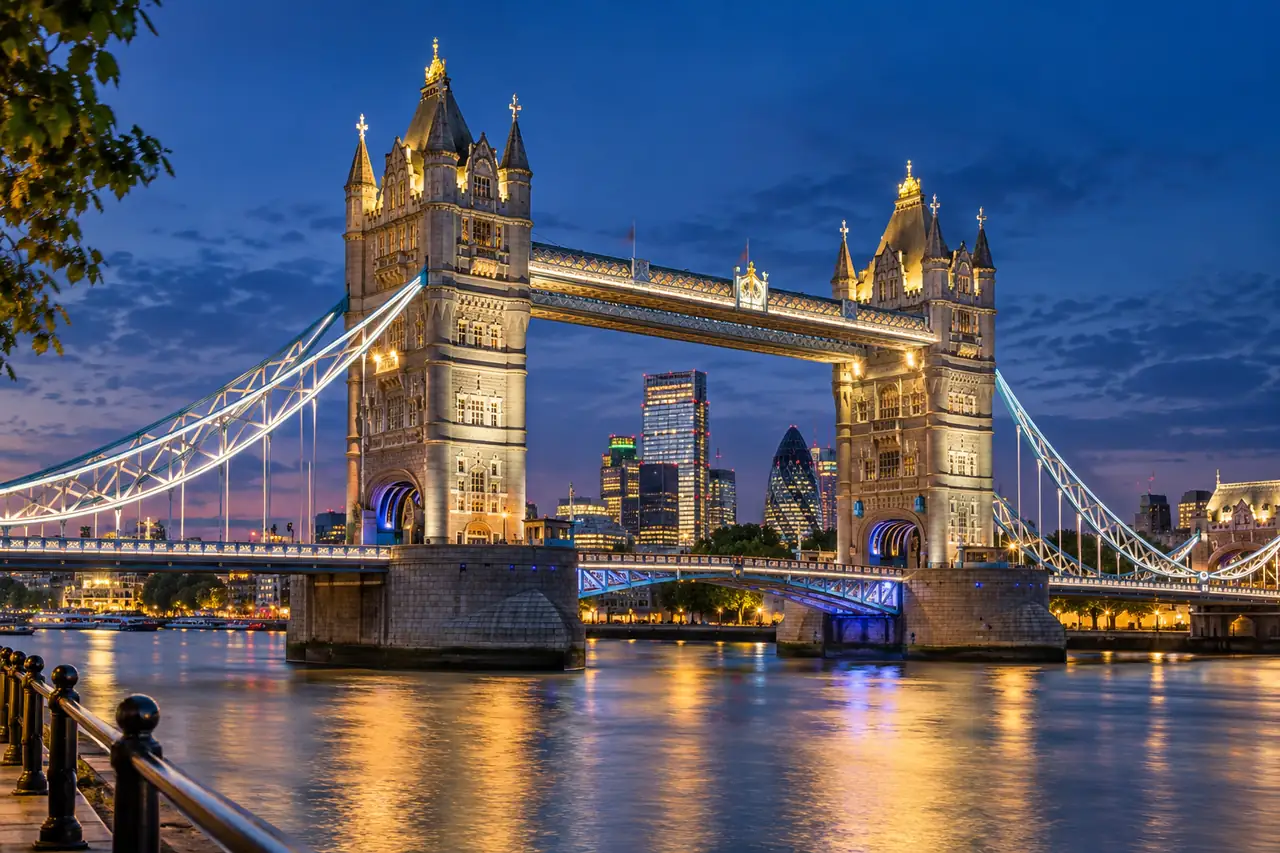
A growing London needed another crossing east of the Tower of London, but the river still had to carry ships into the Pool of London. The solution joined road traffic and working waterways in one structure. Its moving centre remains the key to understanding the entire design.
Eight years in the making
Architect Horace Jones and engineer John Wolfe Barry developed the accepted design. Construction began in 1886 and the Prince of Wales formally opened the bridge on 30 June 1894. Beneath its historic appearance lies a large steel framework, clad in granite and Portland stone. The apparently medieval landmark is distinctly Victorian.
The mechanics behind the movement
The two central leaves are bascules: balanced sections that rotate around pivots. Originally, steam engines pumped water into pressurised accumulators, storing energy until a lift was needed. That energy drove the mechanism that raised the roadway. An electric, oil-hydraulic system replaced the steam-powered arrangement in 1976.
What to notice
Trace the contrast between the slender high-level walkways and the heavy masonry towers. Then look at the centre of the road and imagine its two halves rotating upwards. The preserved engines make the hidden process easier to picture: boilers, pumps and stored pressure turned the bridge into a carefully coordinated machine.
Three details to keep.
- Bascule is a French word associated with a seesaw.
- The high-level walkways stand 42 metres above the Thames.
- The Harbour Master's cutter Daisy was the first vessel through at the royal opening.
A place through time.
Construction begins on the new river crossing.
The bridge receives its royal opening.
Electric oil-hydraulic machinery replaces steam power.
Visitors begin exploring inside the bridge.
Follow the story further.
Explore the official history and interpretation below. For practical visitor details, use the organisation’s current information.
Discover the official Tower Bridge stories ↗The YouTube link opens search results, not a selected or endorsed video. Images on this example site are generated artistic interpretations, not documentary photographs.