Overview
Stonehenge stands within a wider prehistoric landscape of earthworks and burial monuments. Its surviving stones are one chapter in a long sequence of building and rearrangement. The setting helps explain why archaeologists study the surrounding ground as carefully as the stone circle itself.
A monument made in stages
Around 3000 BC, people dug a circular enclosure with banks and a ditch. Cremated remains show that the early monument served as a cemetery. The major stone settings followed around 2500 BC. Later communities altered the arrangement, while Bronze Age burial mounds added another layer to the surrounding landscape.
Stone, distance and organisation
The builders combined large sarsens with smaller stones collectively called bluestones. Some bluestones came from the Preseli Hills in south-west Wales, more than 150 miles away. Moving and raising them required planning, labour and supplies; the precise transport methods remain uncertain. The scale suggests an undertaking that extended well beyond the people handling each stone.
What to notice
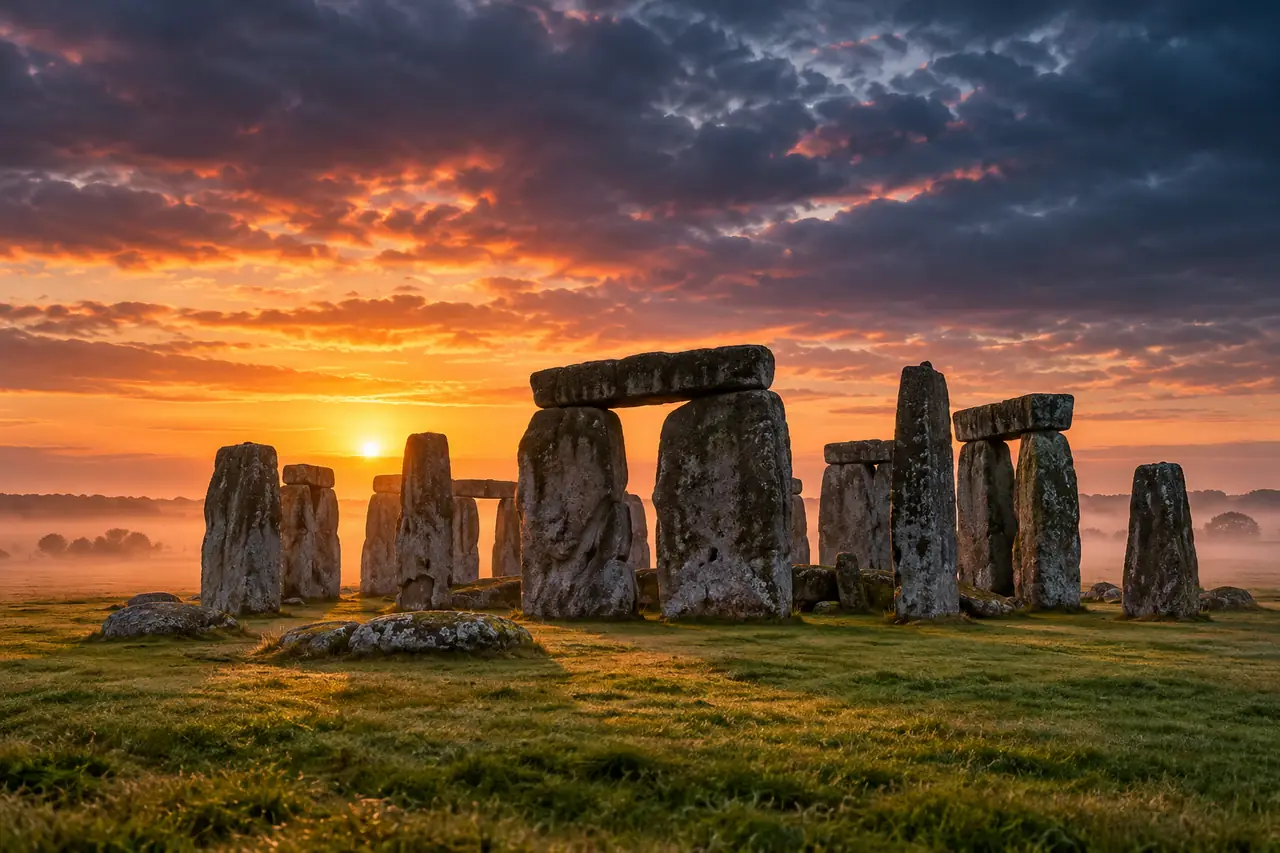
Look for the relationship between upright stones, horizontal lintels and the open sky. The central arrangement aligns with the summer-solstice sunrise and winter-solstice sunset. That astronomical relationship is well supported; a single, complete explanation of the monument's purpose is not. Notice how much of its story remains a question rather than a settled answer.
Three details to keep.
- The early enclosure contained a ring of 56 pits called the Aubrey Holes.
- The stone circle is roughly 500 years younger than the first major enclosure.
- Stonehenge belongs to a wider World Heritage Site shared with Avebury.
A place through time.
Large timber posts are erected in the nearby landscape.
The first major circular enclosure is created.
The principal stone settings are raised.
Burial mounds accumulate around the monument.
Follow the story further.
Explore the official history and interpretation below. For practical visitor details, use the organisation’s current information.
Explore the English Heritage history ↗The YouTube link opens search results, not a selected or endorsed video. Images on this example site are generated artistic interpretations, not documentary photographs.