Overview
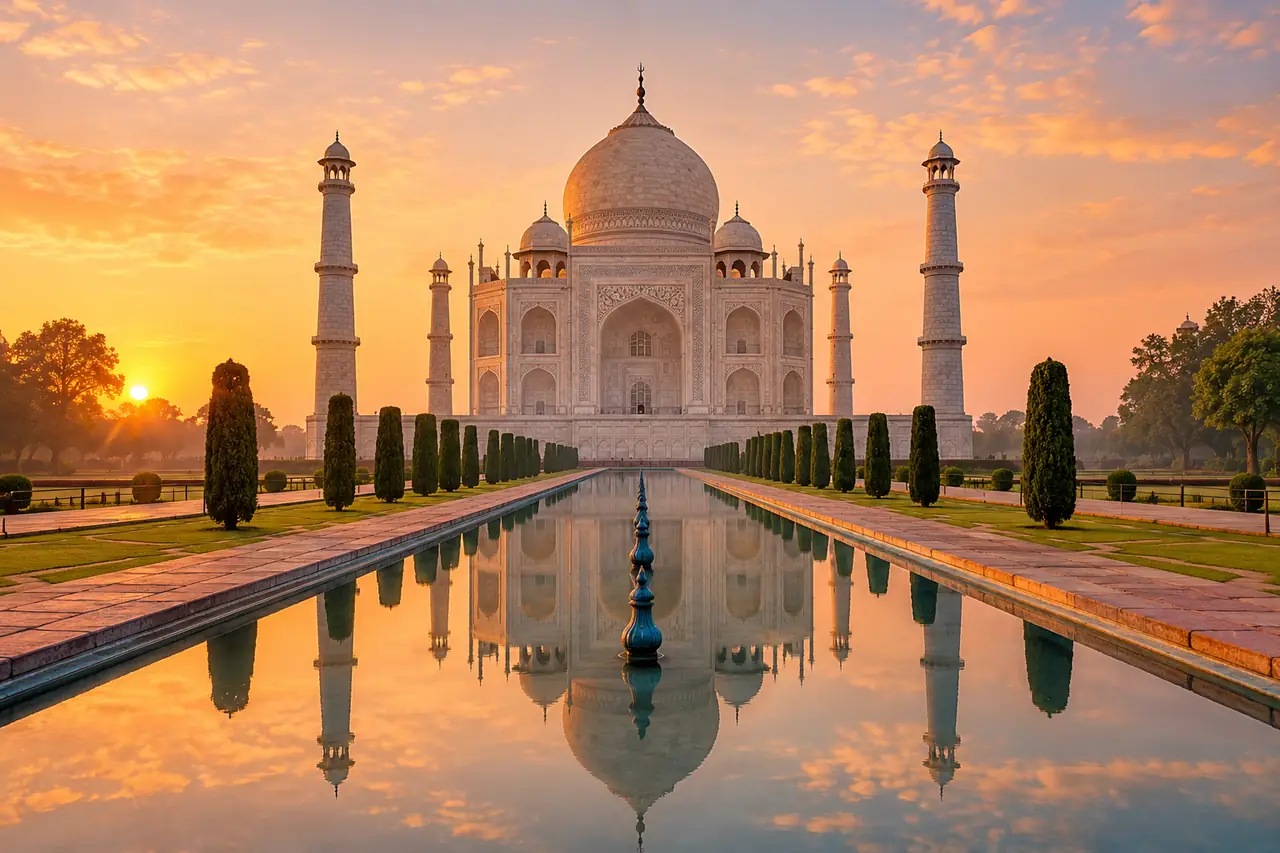
Shah Jahan commissioned the Taj Mahal in memory of Mumtaz Mahal. The complex belongs to the Mughal tradition of monumental garden tombs. Its controlled geometry and elaborate decoration turn a place of remembrance into an architectural statement, bringing grand scale and close craftsmanship into the same view.
A complex built over decades
UNESCO dates the start of construction to 1632 and the completion of the principal mausoleum to 1648. Work on the surrounding buildings continued until 1653. Craftspeople brought skills in stone carving, inlay, calligraphy and dome construction. The ensemble is best read as their coordinated work rather than as a solitary white building.
Symmetry with a clear hierarchy
The design places paired elements around a strong central axis. White marble gives the mausoleum visual priority over the red sandstone of neighbouring structures. Repeated shapes connect the different parts, while increasingly rich decoration directs attention towards the tomb. Its riverside position also gives the garden a distinctive sense of depth.
What to notice
Start with the overall arrangement, then move to smaller details: carved flowers, coloured stone inlay and the marble lattice around the cenotaphs. Observe how light catches relief work and changes the apparent colour of the surfaces. The visual impact depends on both carefully controlled repetition and exceptional attention to individual details.
Three details to keep.
- The mausoleum stands at one end of the four-part garden, rather than at its centre.
- The visible cenotaphs are memorials; the actual graves lie in a lower chamber.
- Four freestanding minarets frame the raised platform around the tomb.
A place through time.
Construction begins, according to UNESCO's chronology.
The principal mausoleum is completed.
The wider complex is completed.
The Taj Mahal joins the World Heritage List.
Follow the story further.
Explore the official history and interpretation below. For practical visitor details, use the organisation’s current information.
Read UNESCO's Taj Mahal profile ↗The YouTube link opens search results, not a selected or endorsed video. Images on this example site are generated artistic interpretations, not documentary photographs.