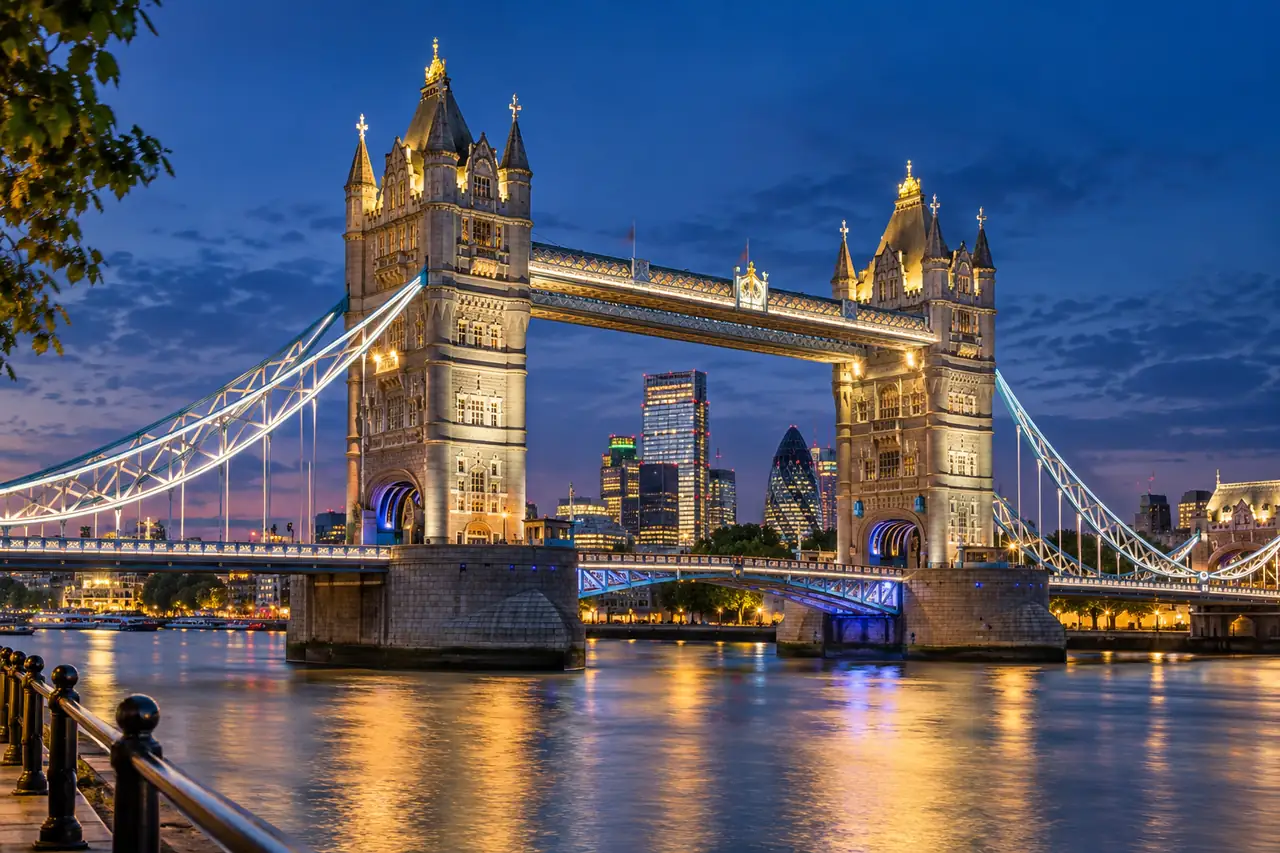
A practical brief, a lasting image.
Some of the most recognisable landmarks begin with a practical challenge. Tower Bridge had to provide another crossing while preserving access for ships. The Eiffel Tower was built for the 1889 Universal Exhibition. Their original contexts differ, but both show how engineering can become a visible statement about a city’s ambitions. Neither is understood fully by looking at its outline alone.
The work behind the silhouette.
Tower Bridge combines an apparently historic exterior with a steel skeleton and moving bascules. Its original steam-powered hydraulic system stored energy until a lift was needed. The Eiffel Tower makes its iron structure far more visible. One wraps engineering in a monumental architectural language; the other allows the structural lattice to dominate the experience. Both invite the viewer to imagine forces, loads and movement.
Why the details change the story.
A postcard compresses a place into a recognisable shape. Details restore the questions that shape leaves out. Where does the load travel? How does a mechanism move? Which components need inspection or replacement? These questions connect the finished landmark to the people who designed, assembled and maintained it. A famous structure is also a continuing technical responsibility.
An icon is still a working place.
Recognition can make a building seem fixed in time, even when its systems and uses have changed. Tower Bridge’s lifting machinery was modernised in 1976. That change is part of its history, not an interruption to it. Reading official histories helps distinguish original construction from later adaptation, and gives a more useful picture than the idea of an untouched monument.
Continue with the field guide.
These editorial reflections draw on the histories linked in our landmark profiles. Read the profiles for dates, architectural details and direct links to the organisations caring for the sites.